Key takeaways
- The body's internal clock controls metabolism, hormones, sleep and cell repair in a precise 24-hour cycle.
- Eating, exercising and sleeping at fixed times every day is the most effective way to stabilize the circadian rhythm.
- Insulin sensitivity is highest in the morning and decreases throughout the day — eat the largest meals early.
- Blue light in the evening from screens suppresses melatonin — use night mode on devices or blue light blocking glasses.
Medical disclaimer: Content is for informational purposes and does not replace medical advice.
The biological clock — how your body keeps time
The body's master clock in the brain's hypothalamus receives light signals through the eyes and synchronizes the body's approximately 24-hour rhythm with the day-night cycle of the outside world. This clock controls the secretion of melatonin in the evening — the sleep hormone that makes you tired — and cortisol in the morning, which wakes you up and increases alertness. But it is not the only clock: almost all organs have their own peripheral clocks, which are controlled by the master clock as well as by local signals such as meal timing and physical activity. PMID 34608825 PMID 34608826
The body's internal clock is approximately 24.2 hours long — slightly longer than a calendar day — and must therefore be reset every day. The primary reset signal is light, especially the blue light of the morning sky. Secondary cues include meals, exercise, and social interaction. When these signals conflict — for example, when you eat late at night when your metabolism is low — an internal desynchronization occurs that can disrupt metabolism, sleep, and hormone balance. PMID 34608825 PMID 34608826

Blue Light Blocking Sleep Glasses
Specialized amber-lens glasses blocking 99% of blue light at night for natural melatonin production.
- Blocks 400-500nm screen light & LEDs
- Enhances deep sleep & REM phases
Eating and chronobiology — timing is as important as content
Your body's ability to handle food changes dramatically throughout the day. Insulin sensitivity — the muscle's ability to absorb glucose — is 30-40% higher in the morning than in the evening. This means that the same meal produces a lower glucose response if you eat it earlier in the day. This has direct implications for metabolic health: people who eat their main meal early in the day have lower HbA1c, lower weight and better insulin sensitivity than people who eat the same meal late in the evening. PMID 34608825 PMID 32406925 PMID 31329264
Time-restricted eating — a form of intermittent fasting where you limit your eating window to, say, 8-10 hours during the day — is one of the most well-studied chronobiological interventions. Meta-analyses show that an early eating window (for example, 8am-4pm) gives better metabolic results than a late window (12pm-8pm), even with the same caloric intake. This is because the body is programmed to handle nutrient intake during the day and fasting at night. PMID 34608825 PMID 32406925 PMID 31329264
| Circadian Time Block | Physiological Metabolic State | Optimal Chronobiological Recommendation |
|---|---|---|
| Morning (06:00 – 10:00) | Peak insulin sensitivity, elevated cortisol awakening response | Consume the largest, protein- and fiber-dense meal of the day; seek direct outdoor sunlight |
| Midday (11:00 – 14:00) | Stable glycemic tolerance and peak cognitive analytical capacity | Substantial balanced lunch with clean protein, low-GI carbohydrates, and healthy fats |
| Late Afternoon (15:00 – 18:00) | Peak core body temperature, maximal muscular strength and lung capacity | Ideal window for high-intensity training or heavy resistance exercise; lighter dinner |
| Night (20:00 – 06:00) | Pineal melatonin secretion, suppressed pancreatic insulin output | Close feeding window completely; maintain 3-hour fast pre-bed to preserve deep slow-wave sleep |
Training and circadian rhythm — when is it best to train?
Muscle strength, body temperature and reaction time all follow a circadian rhythm and typically peak between 14 and 18. In this time window, neuromuscular coordination is at its best, body temperature is highest, which reduces the risk of injury, and oxygen uptake is optimal. It is therefore no coincidence that most world records in sports are set in the afternoon. PMID 34608825 PMID 34608826 PMID 32160084
But that doesn't mean training outside of this window is wasted. Morning workouts can be just as effective in building strength and conditioning over time — the key is consistency. If you train in the morning, ensure a good warm-up, as muscles and joints are less flexible. Avoid intensive training very late at night — the increased body temperature and sympathetic activation can delay sleep by 1-2 hours. PMID 34608825 PMID 34608826 PMID 32160084
Practical measures to optimize your circadian rhythm
The most effective strategy for stabilizing the circadian rhythm is to go to bed and get up at the same time every day — including weekends. Irregular sleep rhythm — social jet lag — is associated with increased risk of metabolic syndrome and weight gain. Morning light is the strongest signal to reset the clock: spending 10-15 minutes outdoors within the first hour after waking can significantly improve the quality of sleep in the evening. PMID 34608826 PMID 32406925 PMID 32160084
Evening lighting is equally important. Blue light from screens, LED bulbs and ceiling lights suppress melatonin production and advance the clock — making it harder to fall asleep. Use night mode or blue light filter on phone and computer after 20, dim the lighting in the home, and consider blue light blocking glasses if you are particularly sensitive. Eating time is also a clock signal: eating within a fixed 10-12 hour window daily stabilizes both the metabolic clock and the sleep rhythm. PMID 34608826 PMID 32406925 PMID 32160084
Internal Further Reading
Read also in the same cluster
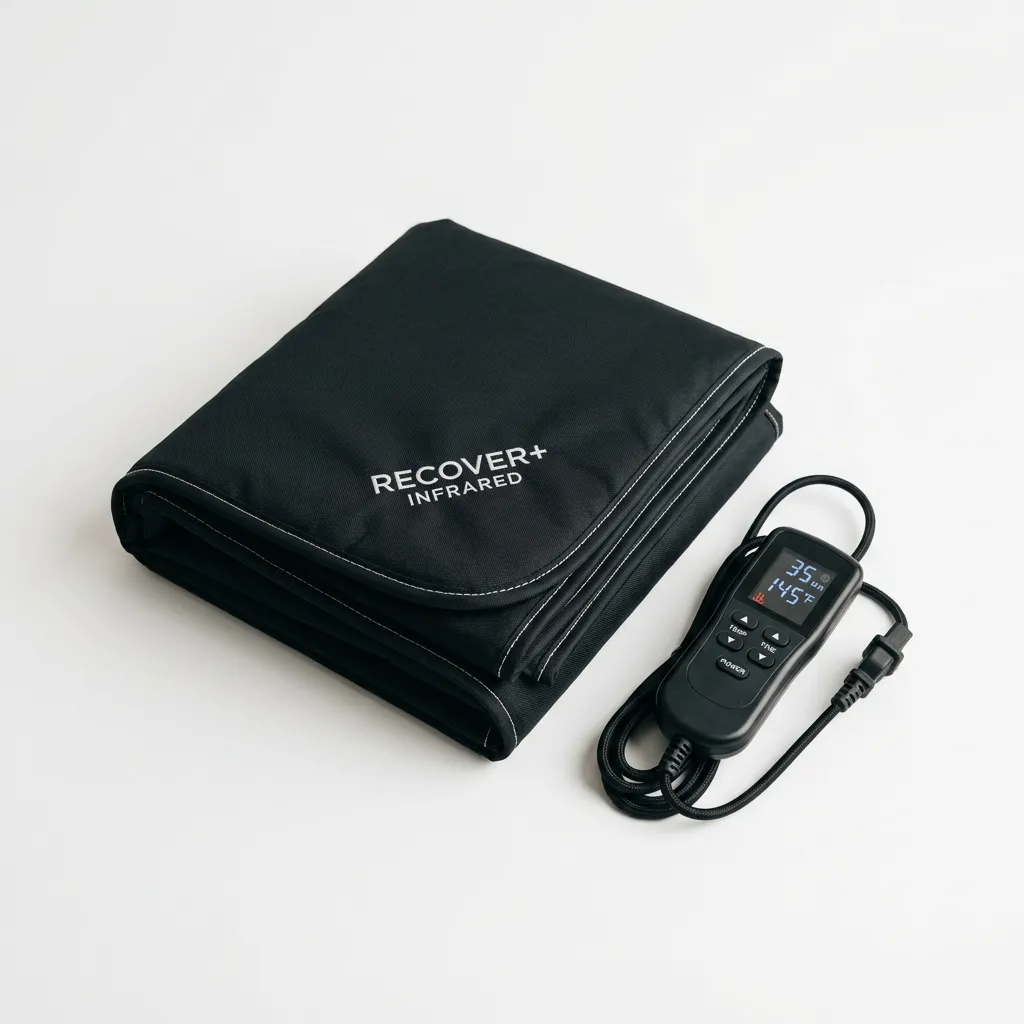
Infrared Sauna Blanket for Home Use
Infrared sauna blanket delivering deep thermal therapy, triggering heat shock proteins (HSP) and circulation.
- Far-infrared deep penetrating heat
- Triggers autophagy response & calorie burn
FAQ
What is social jet lag?
Social jet lag is the difference between your sleep rhythm on working days and on days off. More than 1 hour difference is associated with increased risk of metabolic syndrome and obesity.
Can I reset my circadian rhythm if I've messed it up?
Yes. Morning light is the strongest signal — 15-30 minutes outdoors at the same time each morning for 1-2 weeks can reset the clock. Combine with a fixed bedtime and mealtime.
Is night work dangerous to health?
Prolonged night work is associated with an increased risk of breast cancer, cardiovascular disease and metabolic syndrome. WHO classifies night work as probably carcinogenic.
When should I take vitamin D — morning or evening?
In the morning. Vitamin D can interfere with melatonin production if taken in the evening. Take it with a meal as it is fat soluble.
Sources and References
- [1]
- [2]
- [3]
- [4]
Show all 5 sources (1 more)
- [5]
Editorial History
27. June 2026
First publication
Initial version was published as part of the healthy aging with introduction, takeaways, FAQ, and reference block.
27. June 2026
Medical review
Phrasing, caveats, and internal links were reviewed for clarity, consistency, and YMYL alignment.
27. June 2026
Latest update
Chronobiology — eat, exercise and sleep in sync with your internal clock for better health received updated metadata, reference outputs, and improved decision-support structure.

Medical Review
Medical Review and Update Process
This article has been medically reviewed by Vadim Doroshenko with a focus on clinical accuracy, sources, disclaimers, and whether the conclusions still align with current scientific evidence.

Editorial Profile
Borys Viktorovytj Riabtsev
Borys Viktorovytj Riabtsev publishes Longevity Lab as a research-backed information project on precision medicine, metabolic health, and healthy aging, utilizing rigorous sources, independent medical review, and objective YMYL communication.