Key takeaways
- DEXA provides the most accurate measurement of fat mass, muscle mass and bone density in a single scan.
- Bioimpedance is faster, cheaper, and more readily available, but accuracy varies with fluid balance and device quality.
- For people on GLP-1 courses or in targeted weight loss, body composition is far more informative than BMI alone.
- Repeated measurements with the same method and under the same conditions are more important than absolute precision.
Medical disclaimer: Content is for informational purposes and does not replace medical advice.
Why body composition is more important than weight and BMI
BMI has been the dominant measure of weight status for decades, but it has well-known limitations. BMI does not distinguish between fat and muscle, meaning that a muscular person may be classified as overweight, while a person with a normal BMI may have too much fat and too little muscle. This phenomenon, known as normal-weight obesity, is associated with metabolic risk in line with classical obesity. PMID 19369381 PMID 15042239
For older adults, the loss of muscle mass, sarcopenia, is a key issue that BMI completely overlooks. A person can have a stable weight and at the same time lose several kilograms of muscle mass per year, which increases the risk of falls, loss of function and metabolic deterioration. Therefore, direct measurement of body composition is relevant for anyone working seriously on healthy ageing. PMID 19369381 PMID 15042239
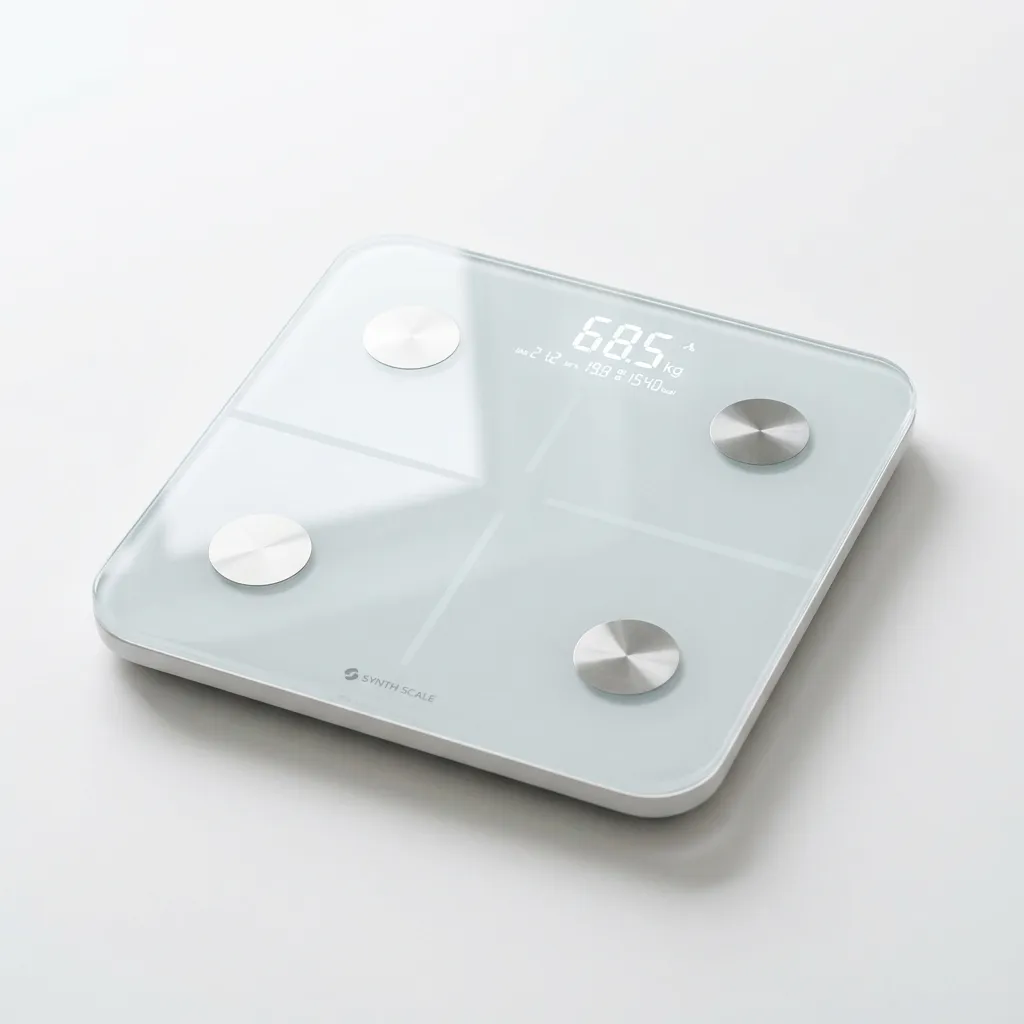
Smart Body Composition Scale
Advanced bioimpedance scale tracking muscle mass, body fat percentage, bone density and hydration.
- Tracks muscle mass & visceral fat
- Wireless sync with health apps
DEXA — the gold standard for body composition
DEXA stands for Dual-Energy X-ray Absorptiometry. The method uses two weak x-rays with different energy levels to distinguish between fatty tissue, lean tissue and bone mineral. The result is a detailed tripartition of the body's composition, often with regional divisions (arms, legs, torso). PMID 15042239 PMID 30312372
The advantages of DEXA include high precision, good reproducibility and simultaneous measurement of bone density, which is relevant for osteoporosis assessment. The disadvantages are that the scan requires special equipment, typically costs DKK 500-1500 per scan in Denmark, and involves a very low radiation dose. For most, the diagnostic benefit is greater than the minimal radiation risk, but the method is not suitable for frequent monitoring for that reason alone. PMID 15042239 PMID 30312372
Bioimpedance — readily available but more sensitive to day shape
Bioimpedance analysis (BIA) sends a weak electric current through the body and measures the resistance, the impedance. Adipose tissue conducts electricity less well than muscle tissue because muscle contains more water and electrolytes. Based on the impedance, the device estimates fat percentage, muscle mass and total body water. PMID 30312372 PMID 28815612
BIA devices come in many forms: from simple bath scales with four electrodes to advanced clinical devices with eight electrodes. The precision varies enormously. Clinical BIA devices can provide useful estimates, while consumer models often have large measurement uncertainties. In addition, BIA measurements are affected by hydration status, recent food intake, exercise, menstrual cycle and alcohol intake. PMID 30312372 PMID 28815612
Comparison and practical decision filter
The choice between DEXA and BIA depends on your purpose. If you need accurate baseline and follow-up — for example, before, during and after a GLP-1 course — DEXA is the best choice. If you want continuous trends and have access to the same BIA device under standardized conditions, BIA may be sufficient. PMID 28815612 PMID 31591555
A combination may also make sense: DEXA as an annual or semi-annual gold standard measurement, supplemented with BIA for more frequent trend monitoring. But remember that BIA changes of less than 1-2 percentage points are often within the measurement uncertainty and should not be over-interpreted. PMID 28815612 PMID 31591555
This is how you get the most out of your measurement
Whichever method you choose, standardization is essential. Measure under the same conditions each time: same time of day, same fluid balance, same time since last workout and meal. For BIA, it is especially important to avoid measurement right after exercise, large meals or alcohol intake, as this can significantly distort the results. PMID 31591555
Do not compare numbers across different devices or methods. A fat percentage of 25% from a bathroom scale can easily correspond to 30% on DEXA. Always use the same device for follow-up and focus on changes over time rather than single measurements. PMID 31591555
3-Compartment DEXA as Gold Standard: Photon Absorption and Bone Density
Dual-energy X-ray absorptiometry (DEXA) represents the undisputed scientific benchmark for evaluating human body composition. While conventional scales and basic anthropometric tools restrict assessments to a crude two-compartment model (fat mass vs fat-free mass), a whole-body DEXA scan segments the physique into **three discrete biological compartments**: bone mineral content (BMC), non-bone lean soft tissue (skeletal muscle and organ parenchymal mass), and fat mass (adipose tissue). PMID 19369381 PMID 28815612
The system utilizes two distinct X-ray photon energy peaks (typically 38–40 keV and 70 keV). Because skeletal bone, lean soft tissue, and adipose triglycerides exhibit distinct elemental densities and atomic attenuation coefficients, they attenuate the dual beams differentially. This enables millimeter-level regional quantification free from assumptions about systemic water balance. The ionizing radiation dose of a modern total-body DEXA scan is exceptionally negligible — typically 1 to 4 microsieverts (uSv), comparable to the natural environmental background radiation received by a European resident over a few hours or during a single short flight. PMID 19369381 PMID 28815612
Bioelectrical Impedance (BIA): Multi-Frequency Metrics, Fluid Shifts, and Pitfalls
Bioelectrical impedance analysis (BIA), utilized across consumer smart scales and high-tier medical analyzers such as the InBody 770 or Seca mBCA, operates by introducing imperceptible alternating micro-currents through tactile hand and foot electrodes. The instrumentation quantifies two electrical properties: pure ionic resistance (**resistance**, inversely correlated with water and electrolyte volume) and cell membrane capacitance (**reactance**). PMID 15042239 PMID 31591555
Advanced multi-frequency BIA applies spectrums ranging from 1 kHz (which traverses strictly through extracellular water, ECW) up to 1,000 kHz (which crosses cellular lipid bilayers to measure total body water, TBW). Crucially, however, BIA translates electrical conductivity into muscular and adipose mass via regression algorithms that assume a fixed muscular hydration fraction of 73.2%. Consequently, if you are mildly hypohydrated, have loaded carbohydrates that transiently sequester intracellular glycogen-bound water, or just completed exercise, BIA systems misinterpret fluid shifts as dramatic, spurious changes in body fat percentage. PMID 15042239 PMID 31591555
| Metric Dimension | Whole-Body DEXA Scan | Professional Multi-Frequency BIA (InBody) |
|---|---|---|
| Analytical Principle | Dual-energy photon attenuation (elemental density) | Electrical impedance and phase angle (conductive fluid) |
| Compartment Framework | 3-Compartment (Bone mineral, lean soft tissue, fat) | Modeled 2/3-compartment dependent on assumed hydration |
| Visceral Adipose Tissue (VAT) | Direct quantification of intra-abdominal area (cm²) & mass (g) | Algorithmic proxy (visceral fat index / level) |
| Bone Mineral Density (BMD) | High-precision T-score and Z-score (osteopenia/osteoporosis) | Non-measurable via electrical bioimpedance |
| Hydration Sensitivity | Invariant to acute hydration and glycogen variations | Substantial (1–2 kg swings from sodium/fluid shifts) |
| Availability & Cost in DK | 1,200–2,000 DKK at private hospitals and longevity clinics | Complimentary in gyms or 150–350 DKK at clinical centers |
Crucial Longevity Targets: ALMI Against Sarcopenia and Visceral Fat (VAT)
In preventive longevity protocols, total body mass index (BMI) is thoroughly inadequate. Two definitive anatomical metrics dictate cardiometabolic aging and frailty trajectory: PMID 19369381 PMID 30312372 PMID 28815612
1. **Appendicular Lean Mass Index (ALMI)**: The cumulative skeletal muscle mass residing strictly within the upper and lower extremities divided by height squared (kg/m²). The European Working Group on Sarcopenia in Older People (EWGSOP2) establishes that an ALMI below 7.0 kg/m² in men and below 5.5 kg/m² in women signals clinically meaningful muscle depletion. Preserving high ALMI is among the strongest predictors of lifelong functional autonomy and low all-cause mortality. 2. **Visceral Adipose Tissue (VAT)**: The metabolically sinister adipose depot packed deep within the peritoneal cavity surrounding the mesenteric vasculature and liver. Unlike subcutaneous fat, visceral adipose tissue discharges high flux inflammatory cytokines (IL-6, TNF-alpha) directly into the hepatic portal vein. DEXA quantifies this pro-atherogenic depot in square centimeters (cm²) or grams: An optimal longevity benchmark is maintaining VAT below 50–100 cm² (or <500 g). PMID 19369381 PMID 30312372 PMID 28815612
Internal Further Reading
Read also in the same cluster

Outlive: The Science & Art of Longevity
Dr. Peter Attia's groundbreaking guide to preventive medicine, exercise for longevity, and healthy aging.
- Scientific framework for Medicine 3.0
- Actionable guide on sleep, exercise & nutrition
FAQ
How often should I measure my body composition?
For most, a DEXA scan once a year or every six months is sufficient. More frequent BIA measurements can provide trends, but daily measurements often create more noise than utility.
Can I trust my bathroom scale's body composition measurement?
Only as a very rough trend. The absolute numbers are often imprecise. If you use a bath scale, focus on direction over weeks and months, not on day-to-day fluctuations.
Is DEXA scan dangerous due to radiation?
No, the radiation dose is very low — typically less than a single day's background radiation. The benefits of accurate body composition usually outweigh the minimal risk.
What is a healthy body fat percentage?
It depends on gender and age. In general, 10-20% for men and 20-30% for women are considered healthy for younger adults, but the ranges shift upwards with age. More important than a single number is the distribution and the trend over time.
Why is body composition important during a GLP-1 course?
Because GLP-1 can lead to both fat and muscle loss. Without measuring body composition, you cannot know if the weight loss is healthy or if you are losing too much muscle mass, which can be harmful in the long term.
Why does my home smart scale or InBody analyzer show sudden daily shifts in body fat?
Bioimpedance calculates tissue mass based on electrical fluid conductivity, assuming muscle tissue maintains a static 73.2% water fraction. Shifts in hydration, dietary sodium, late-night carbohydrates, or rigorous workouts perturb electrolyte fluid compartments, which the algorithm mistakenly registers as changes in fat tissue.
Is the ionizing radiation from an annual whole-body DEXA scan dangerous?
No. The effective radiation dose of a total-body DEXA scan is negligible (approx. 1–4 uSv). In contrast, the average annual natural background radiation in Denmark is 2,000–3,000 uSv, and a transatlantic flight exposes passengers to roughly 40–60 uSv.
Where in Denmark can a private individual get a DEXA body scan without a physician referral?
Whole-body DEXA body composition scans are available out-of-pocket at private hospitals (such as Aleris and Capio) as well as private sports medicine and longevity clinics in Copenhagen and Aarhus, typically costing between 1,200 and 2,000 DKK.
Sources and References
- [1]
- [2]
- [3]
- [4]
Show all 5 sources (1 more)
- [5]
Editorial History
31. May 2026
First publication
Initial version was published as part of the healthy aging with introduction, takeaways, FAQ, and reference block.
31. May 2026
Medical review
Phrasing, caveats, and internal links were reviewed for clarity, consistency, and YMYL alignment.
4. July 2026
Latest update
Body composition received updated metadata, reference outputs, and improved decision-support structure.

Medical Review
Medical Review and Update Process
This article has been medically reviewed by Vadim Doroshenko with a focus on clinical accuracy, sources, disclaimers, and whether the conclusions still align with current scientific evidence.

Editorial Profile
Borys Viktorovytj Riabtsev
Borys Viktorovytj Riabtsev publishes Longevity Lab as a research-backed information project on precision medicine, metabolic health, and healthy aging, utilizing rigorous sources, independent medical review, and objective YMYL communication.