Key takeaways
- Finger prick is best when you need a single blood based point.
- CGM is best when you want to see waveforms, timing and repetitive everyday patterns.
- Sensor and fingerstick may differ, especially when glucose changes rapidly.
- If symptoms do not match the sensor reading, do not ignore the symptoms.
Medical disclaimer: Content is for informational purposes and does not replace medical advice.
The practical difference
A finger prick is simple: you draw blood, use a test strip and get a number. It is a point in time. CGM is different: a sensor sits under the skin and continuously transmits data about glucose in interstitial fluid. It provides more data points, but also more interpretation. PMID 36232460 PMID 30061471 PMID 34101673
For a person without diabetes, the big difference is therefore not just comfort. It is the data type. Finger prick can confirm a time. CGM can show if a pattern repeats itself after certain meals, sleep periods, or exercise days. PMID 36232460 PMID 30061471 PMID 34101673
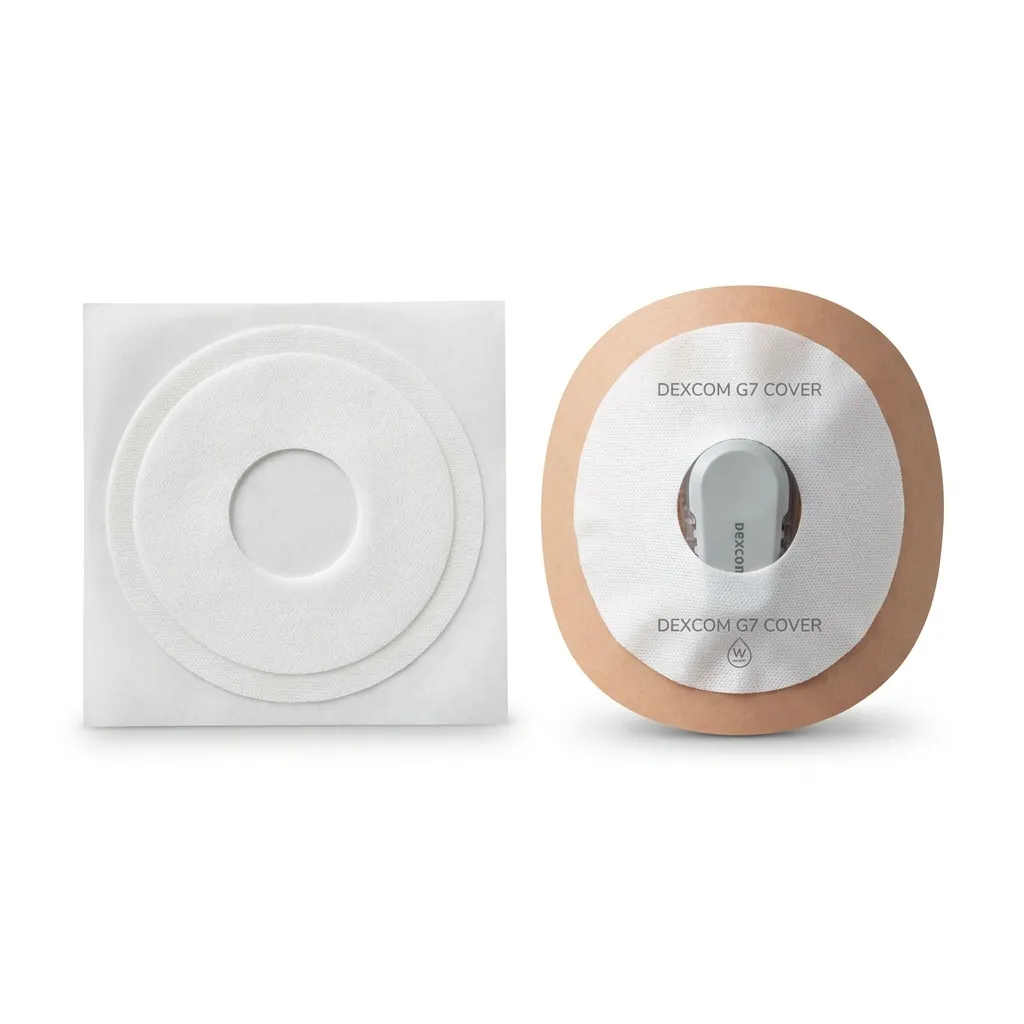
Waterproof Sensor Covers for Dexcom G7 & CGM
Waterproof and breathable patches to protect continuous glucose monitors during exercise and bathing.
- Waterproof & sweatproof up to 14 days
- Hypoallergenic latex-free medical adhesive
When finger prick still makes sense
Finger prick is not old-fashioned just because CGM exists. If you need a simple blood-based check, or if the sensor and symptoms do not match, a blood glucose meter is still relevant. Stelo himself writes that a blood glucose meter can be an option when readings do not match how you feel. PMID 30061471 PMID 30626854 PMID 31177183
This does not mean that everyone without diabetes should measure the finger prick. It just means that finger prick still has a distinct role as point measurement, while CGM has a role as trend measurement. PMID 30061471 PMID 30626854 PMID 31177183
When CGM gives more than finger prick
CGM makes the most sense when the question is about progression. How long do you lie high after a meal? Does the morning curve look different after poor sleep? Does the curve drop faster if you go for a walk after dinner? These are the kinds of questions a single finger prick has a hard time answering. PMID 36232460 PMID 34101673 PMID 31177183
But more data is not automatically better data. A CGM waveform can make normal physiological variations more dramatic if you don't have a plan of what to look for. PMID 36232460 PMID 34101673 PMID 31177183
Why the numbers don't always match
CGM and finger prick can show different numbers because they do not measure in the same tissue. Finger prick measures blood glucose while CGM measures interstitial glucose. When glucose rises or falls rapidly, interstitial glucose may lag behind blood glucose. PMID 30626854 PMID 31177183
In addition, practical conditions can affect the result: hand hygiene when finger pricking, old test strips, pressure on sensor, new sensor or technical problems. Therefore, it is often wrong to treat a small difference as a big biological story. PMID 30626854 PMID 31177183
The conclusion for people without diabetes
If you do not have diabetes, CGM makes the most sense as a short learning curve around behavior and patterns. Finger pricking makes the most sense as a spot check or safety layer in certain situations. Neither should be used as an independent diagnosis. PMID 36232460 PMID 34101673 PMID 31177183
The best strategy is therefore to choose the tool according to the question. If you want to understand a pattern, CGM can be useful. If you want to know a point, finger pricking can be enough. If you want to assess risk, you must include blood tests and a professional context. PMID 36232460 PMID 34101673 PMID 31177183
Interstitial Fluid vs Capillary Blood: Physiological Lag Time and Enzymatics
When contrasting a continuous glucose monitor (CGM such as Dexcom or Abbott FreeStyle Libre/Stelo) with a traditional fingerstick blood glucose meter (BGM), the two devices sample completely different physiological compartments. A fingerstick analyzes capillary whole blood, reflecting instantaneous intravascular circulating glucose. In contrast, a CGM sensor samples the interstitial fluid within the subcutaneous adipose tissue through an enzymatic glucose oxidase reaction on a flexible micro-filament. PMID 36232460 PMID 34101673
Glucose must physically diffuse across capillary endothelia into the extracellular space. This transit introduces a physiological **lag time** of approximately 5 to 15 minutes. Under steady-state fasting conditions, readings are nearly congruent. However, following a meal or during strenuous anaerobic exertion, intravascular glucose surges before interstitial levels equilibrate. Conversely, during precipitous drops, the sensor lags behind, creating an apparent discrepancy between fingerstick and sensor readings. PMID 36232460 PMID 34101673
Glycemic Variability and Time-in-Tight-Range (TITR)
The primary clinical limitation of static fingersticks is intermittent temporal sampling. Assessing fasting glucose at dawn and two hours post-dinner obscures all intervening glycemic dynamics. Landmark research from Stanford University (*PLOS Biology*) demonstrated that non-diabetic individuals with clinically normal HbA1c regularly endure transient glucose spikes exceeding 7.8–11.0 mmol/L following ordinary meals — phenotypes termed 'glucotypes'. PMID 30061471 PMID 30626854 PMID 31177183
For longevity medicine, cumulative area under the curve and **glycemic variability** (quantified as the coefficient of variation, % CV) carry substantial biological weight. Sharp glycemic excursions provoke endothelial dysfunction, mitochondrial superoxide overproduction, and accelerated formation of advanced glycation end-products (AGEs). While standard diabetic targets mandate Time in Range (3.9–10.0 mmol/L > 70%), metabolic optimization targets **Time in Tight Range (TITR: 3.9–6.7 mmol/L > 85–90%)** with a % CV maintained below 20–25%. PMID 30061471 PMID 30626854 PMID 31177183
| Parameter | Continuous Biosensor (CGM) | Capillary Fingerstick (BGM) |
|---|---|---|
| Biological Matrix | Interstitial fluid (subcutaneous adipose space) | Capillary whole blood (digit pulp capillaries) |
| Temporal Delay (Lag time) | 5–15 minutes behind capillary dynamics | 0 minutes (instantaneous snapshot) |
| Data Density | 288–1,440 data points per 24h (continuous trend vectors) | 1–4 isolated discrete measurements per day |
| Nocturnal Surveillance | Autonomous continuous recording with alarm thresholds | Impossible without sleep interruption |
| Core Longevity Value | Captures glycemic variability, MAGE, and meal kinetics | Spot confirmation and rapid verification of symptomatic extremes |
Clinical Utility vs the Hazard of Glucose Orthorexia
For non-diabetic adults, perpetual year-round wear of continuous glucose sensors is rarely justified. Clinical evidence supports an **intermittent 2–4 week educational protocol**. This observation window allows you to rigorously test personal glycemic responses to specific dietary staples (e.g., steel-cut oats vs pasture-raised eggs, jasmine rice vs legumes), document how a brisk 10-minute postprandial walk blunts the glucose peak, and recognize the profound insulin resistance caused by a single night of sleep deprivation. PMID 36232460 PMID 30061471 PMID 30626854
A major unintended risk of indiscriminate continuous monitoring is **glucose orthorexia** — an obsessive avoidance of benign, normal glycemic excursions. Postprandial elevations reaching 6.5–7.5 mmol/L after eating fibrous legumes, intact whole grains, or fresh fruit represent healthy physiological dynamics, not metabolic impairment. CGMs should function as diagnostic discovery tools, not anxiety-inducing drivers of extreme carbohydrate restriction. PMID 36232460 PMID 30061471 PMID 30626854
Internal Further Reading
Read also in the same cluster
Smart Body Composition Scale
Advanced bioimpedance scale tracking muscle mass, body fat percentage, bone density and hydration.
- Tracks muscle mass & visceral fat
- Wireless sync with health apps
FAQ
Is CGM more accurate than finger prick?
Not in the simple way. They measure different things: CGM measures interstitial glucose over time, while finger prick measures blood glucose at a single point.
Why doesn't my CGM match my blood glucose meter?
Because glucose in blood and interstitial fluid can shift, especially when levels change rapidly. Practical conditions can also come into play.
Should people without diabetes use finger prick?
Usually not as a routine. However, it may be relevant after clinical agreement or if sensor readings do not match symptoms.
Can CGM without diabetes replace HbA1c?
No. CGM shows dynamics, while HbA1c shows a long-term average and is used in clinical assessment.
Why do my CGM and fingerstick often show conflicting readings simultaneously?
Discrepancies stem from the physiological 5–15 minute lag time between capillary blood and interstitial fluid, alongside analytical margins of error (approx. 9–10% MARD). During rapid glycemic rises the CGM lags behind, whereas during rapid descents the CGM appears higher than fingerstick capillary blood.
What is an optimal target for glycemic variability (% CV) in non-diabetic individuals?
For individuals without diabetes, an optimal coefficient of variation (% CV) is below 20–25%. Lower variability reflects robust insulin sensitivity and fewer oxidative stress surges, provided it is not achieved through severe, disordered dietary restriction.
Is permanent year-round CGM wear necessary for longevity?
No. For most non-diabetic individuals, wearing a 14-day biosensor once or twice yearly is fully sufficient. The objective is to map individualized glycemic responses to diet, exercise, and sleep. Once lifestyle adjustments are cemented, perpetual monitoring offers negligible additional benefit.
Sources and References
- [1]
- [2]
- [3]
- [4]
Show all 5 sources (1 more)
- [5]
Editorial History
9. June 2026
First publication
Initial version was published as part of the metabolic health with introduction, takeaways, FAQ, and reference block.
9. June 2026
Medical review
Phrasing, caveats, and internal links were reviewed for clarity, consistency, and YMYL alignment.
9. June 2026
Latest update
CGM without diabetes vs finger prick received updated metadata, reference outputs, and improved decision-support structure.

Medical Review
Medical Review and Update Process
This article has been medically reviewed by Vadim Doroshenko with a focus on clinical accuracy, sources, disclaimers, and whether the conclusions still align with current scientific evidence.

Editorial Profile
Borys Viktorovytj Riabtsev
Borys Viktorovytj Riabtsev publishes Longevity Lab as a research-backed information project on precision medicine, metabolic health, and healthy aging, utilizing rigorous sources, independent medical review, and objective YMYL communication.