Key takeaways
- Tendons consist primarily of densely packed Type I collagen; age-related stiffness increases tendinopathy risk.
- The Keith Baar protocol: Consuming 15g hydrolysed collagen with Vitamin C 30-60 min pre-workout peaks amino acids in blood during mechanical loading.
- Mechanical strain (compression and stretching of tenocytes) activates lysyl oxidase, creating strong collagen cross-links.
- Hydrolysed collagen peptides (bioactive peptides like Pro-Hyp and Hyp-Gly) directly stimulate tenocyte collagen matrix synthesis.
- Eccentric loading exercises (slow lengthening under resistance) are the most evidence-based exercise mode for tendon remodeling.
- Red and near-infrared light (660nm and 850nm) applied to tendons enhances microcirculation and accelerates tenocyte ATP production.
Medical disclaimer: Content is for informational purposes and does not replace medical advice.
Tendon and Ligament Biology: Why Tendons Heal Slowly
Tendons consist of approximately 80% dry weight Type I collagen organized into elongated fibrils by tenocytes (specialized tendon cells). Embedded between collagen fibers are proteoglycans like decorin, which retain water and provide resistance against tensile and shear forces. PMID 24841276 PMID 27747846
The primary limitation of tendon tissue is its sparse blood supply (hypovascularity). While skeletal muscle possesses a dense capillary bed and heals rapidly, tendons receive nutrients mainly via diffusion from the surrounding tendon sheath and synovial fluid. This diffusion is stimulated by mechanical movement, making 'active recovery' and controlled loading vital for tendon health. PMID 24841276 PMID 27747846
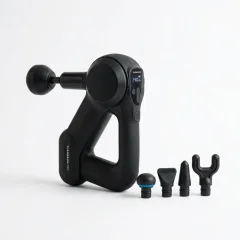
Professional Percussive Massage Gun
High-torque percussive therapy device for deep muscle relief, circulation and post-workout recovery.
- Deep percussive impact for fast relief
- Quiet brushless motor with multiple heads
The Keith Baar Protocol: Hydrolysed Collagen, Vitamin C, and Timing
A breakthrough in sports medicine and geriatric rehabilitation emerged from Prof. Keith Baar's laboratory at UC Davis. His experiments revealed that consuming 10–15 grams of hydrolysed collagen (or gelatin) enriched with 50 mg of Vitamin C exactly 30 to 60 minutes prior to a brief mechanical loading session doubled collagen synthesis markers (PINP) in the blood. PMID 27852613 PMID 30609761
Vitamin C serves as an indispensable cofactor for the enzymes prolyl hydroxylase and lysyl hydroxylase, which hydroxylate proline and lysine residues in collagen. Without sufficient Vitamin C, the stable triple-helix structure that gives tendons their high tensile strength cannot form. PMID 27852613 PMID 30609761
Mechanical Strain and Eccentric Loading: Tenocyte Activation
Nutrients alone cannot rebuild tendon architecture. Tenocytes require mechanical strain (stretching and deformation) to trigger genes responsible for collagen production. This biological process is known as mechanotransduction. PMID 34491424 PMID 27747846
Eccentric loading exercises — where the muscle-tendon unit lengthens under resistance (e.g., slowly lowering the heel during Achilles rehab) — have been proven in clinical meta-analyses (such as Bohm et al.) to be the most effective intervention. It generates high mechanical tension without overloading joint surfaces, upregulating tenocyte collagen matrix remodeling. PMID 34491424 PMID 27747846
Bioactivity of Collagen Peptides: Di- and Tripeptides in Circulation
Researchers previously assumed that ingested collagen was entirely broken down into individual amino acids in the gut. Modern peptide analytics demonstrate that bioactive di- and tripeptides (specifically Proline-Hydroxyproline [Pro-Hyp] and Hydroxyproline-Glycine [Hyp-Gly]) survive digestion and enter systemic circulation intact for several hours post-ingestion. PMID 34491424 PMID 35104800
When these bioactive peptides reach tendon tenocytes, they bind to specific cell surface receptors and send a potent anabolic signal to upregulate lysyl oxidase (LOX). This enzyme forms strong covalent cross-links between collagen molecules, directly increasing tendon structural density. PMID 34491424 PMID 35104800
Complementary Interventions: Red Light, Magnesium, and Rehab Planning
For maximal tissue repair, the pre-workout collagen protocol can be combined with photobiomodulation. Red light (660nm) and near-infrared light (850nm) penetrate deep into tendon tissue, absorbed by cytochrome c oxidase in mitochondria to increase tenocyte ATP synthesis and suppress localized inflammatory cascades. PMID 30783649 PMID 26353786
Supplementary magnesium and zinc support enzymatic cofactors in tissue repair. A typical weekly rehab plan for tendinopathy involves 3 short loading sessions (10-15 minutes of eccentric exercise) per week, with collagen and Vitamin C consumed 45 minutes prior. PMID 30783649 PMID 26353786
Internal Further Reading
Read also in the same cluster
Smart Body Composition Scale
Advanced bioimpedance scale tracking muscle mass, body fat percentage, bone density and hydration.
- Tracks muscle mass & visceral fat
- Wireless sync with health apps
FAQ
When should collagen be taken relative to exercise?
Collagen peptides and Vitamin C should be taken approximately 30 to 60 minutes BEFORE your exercise session. This ensures amino acids and cofactors peak in blood circulation when mechanical loading pumps fluid into the tendon.
Why is Vitamin C required alongside collagen?
Vitamin C is a required cofactor for prolyl and lysyl hydroxylase enymes that stabilize the collagen triple-helix structure. Without Vitamin C, functional collagen fibers cannot be synthesized.
How long does it take to rebuild an injured tendon?
Because tendon tissue has a slow metabolic turnover, remodeling typically requires 3 to 6 months of consistent mechanical loading and nutritional support for full structural restoration.
Sources and References
- [1]
- [2]
- [3]
- [4]
Show all 8 sources (4 more)
- [5]
- [6]
- [7]
- [8]
Editorial History
5. august 2026
Første publicering
Første version blev publiceret som del af healthy aging med intro, takeaways, FAQ og referenceblok.
5. august 2026
Faglig gennemgang
Formuleringer, forbehold og interne links blev gennemgået for klarhed, konsistens og YMYL-tydelighed.
5. august 2026
Seneste opdatering
Tendon Health and Collagen Peptides (2026) fik opdaterede metadata, referenceoutput og forbedret beslutningsnær struktur.

Medical Review
Medical Review and Update Process
This article has been medically reviewed by Vadim Doroshenko with a focus on clinical accuracy, sources, disclaimers, and whether the conclusions still align with current scientific evidence.

Editorial Profile
Borys Viktorovytj Riabtsev
Borys Viktorovytj Riabtsev publishes Longevity Lab as a research-backed information project on precision medicine, metabolic health, and healthy aging, utilizing rigorous sources, independent medical review, and objective YMYL communication.